
The Silent Stream: Understanding How Your Maryland Septic System Protects the Bay
If you live in one of the many lovely rural or semi-rural areas of Maryland, from the rolling hills of the Piedmont to the sandy soil of the Eastern Shore, chances are your home relies on an On-site Sewage Disposal System (OSDS), more commonly known as a septic system. Unlike homes connected to public sewer lines, your property manages its own wastewater treatment plant. Understanding how this system works is crucial for protecting your investment, your family's health, and the delicate ecosystem of the Chesapeake Bay.
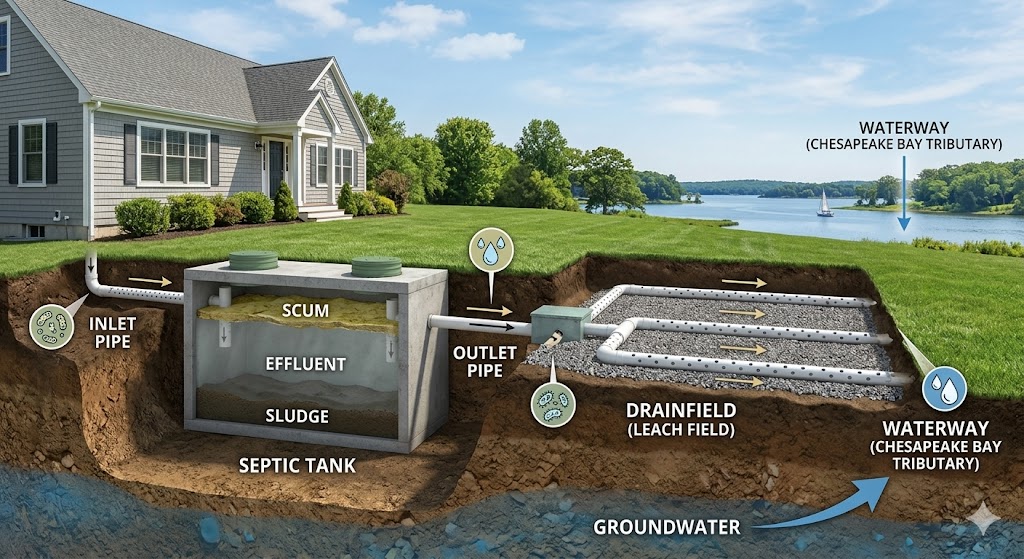
The journey of household wastewater from your toilets, showers, sinks, and laundry, begins when it flows out of your home through a single main drainage pipe into a buried, watertight container called the septic tank. Typically made of concrete, fiberglass, or polyethylene, the tank holds this wastewater long enough to allow a natural separation process to occur. Heavy solids settle to the bottom, forming a layer of sludge, while lighter fats, oils, and grease float to the top as a scum layer. A specific biological process fueled by anaerobic bacteria then gets to work, breaking down some of the organic matter within the liquid layer, now called effluent.
The next critical phase is the distribution and final treatment of the effluent. The now-clarified liquid exits the tank through a T-shaped outlet, leaving the sludge and scum behind. In a conventional system, gravity or a pump moves this effluent to a distribution box, which splits the flow evenly among several perforated pipes buried in a series of gravel-filled trenches or chambers, known as the drainfield. The soil surrounding these trenches accepts, treats, and disperses the wastewater, naturally removing harmful coliform bacteria, viruses, and many nutrients as it percolates downward, ultimately recharging the local groundwater.
In Maryland, the diverse geography means soil and water table conditions vary significantly. As a result, many properties require alternative systems tailored to their specific environment. If you live near the Chesapeake Bay or in areas with shallow soil, a Best Available Technology (BAT) system might be required to reduce nitrogen pollution. These systems often pair an advanced treatment unit with the tank, or use sophisticated dispersal methods like sand-mound systems or low-pressure pipe networks to ensure wastewater receives thorough treatment before entering the environment.
Maintaining your system is not just about keeping the drains moving; it is about protecting our waterways. Proper care means scheduling regular professional inspections and pump-outs, typically every three to five years depending on household size. A healthy septic system ensures that the silent stream flowing from your home is properly managed, preventing costly failures and playing an essential role in Maryland's statewide effort to restore and safeguard the Chesapeake Bay for generations to come.
Categories
Recent Posts









Principal Premier Agent License ID: MD: 644396 | DC: SP40002306
+1(301) 525-7453 | bryan.kerrigan@redfin.com